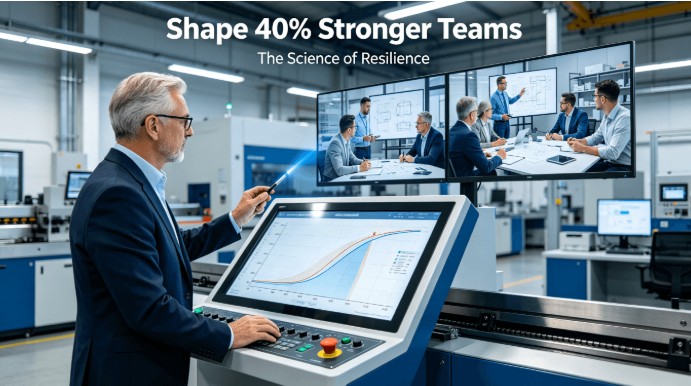
Leaders often watch brilliant ideas or talented teams deform or even snap under pressure — projects delay, quality slips, innovation stalls. Similarly, a product can fail unexpectedly in its first test batch, much like metal fracturing at the wrong stress point. The result is a loss of potential, momentum, and resources, as initiatives and teams fail to live up to their designed promise.
The root cause is often a linear, rigid response to challenges. We push harder without understanding the internal dynamics, much like applying force to metal without knowledge of its grain structure. We lack a systematic “strengthening process” that accounts for internal “stress distribution,” “toughness,” and “fatigue limits.” This article draws on the engineering wisdom of precision metal bending to reveal how pressure can be transformed into a force that shapes excellence. By understanding principles like “springback compensation,” “material selection,” and the “zero-defect mindset,” readers can learn to design more resilient and precise “manufacturing processes” for their teams and products.
How Does the “Bending” Process in Metallurgy Teach Us to Avoid Catastrophic Failure?
The core of metal bending is applying controlled force to induce plastic deformation without causing fracture. This process is a powerful metaphor for leadership and project management. It teaches that pressure, when applied with understanding and support, is a shaping force, not a destructive one. The goal is to achieve the desired new form while preserving the material’s integrity.
1. The Foundation: Understanding Elastic and Plastic Limits
Every material has an elastic limit — the point up to which it will return to its original shape — and a yield point, beyond which permanent, plastic deformation occurs. In teams, this translates to understanding the difference between healthy stretch goals and burnout-inducing overload. Pushing a team within its elastic range builds resilience; pushing it past its yield point without support causes permanent damage, “work hardening” it into a brittle, less effective state.
2. The Critical Role of Support: The V-Die and Back Gauge
In a press brake, the V-die provides essential support, directing the force to create a clean, predictable bend. Without it, the metal would crumple or tear. For a team, this support is the clear framework of goals, resources, psychological safety, and fair leadership. It ensures that pressure is distributed and channeled effectively, preventing local “stress concentrations” that lead to individual burnout and project failure.
3. Predicting Failure: The Forming Limit Diagram
In metallurgy, a Forming Limit Diagram (FLD) is used to scientifically predict how much a sheet can be stretched before failure, considering strain paths. Relying on intuition or “gut feel” for team or project limits is akin to bending metal blindfolded. Success requires a data-informed understanding of capacities. The science of predicting and managing these limits is what separates controlled shaping from catastrophic failure, a principle detailed in industrial resources on custom metal bending service.
Why is “Material Selection” the First Step to “Zero-Defect Living” and Robust Products?
You cannot bend cast iron like you bend copper. The first principle of achieving a flawless outcome — whether a product or a high-performing team — is selecting the right “material” for the task. This means deeply understanding the intrinsic properties, strengths, and limitations of the people, culture, or components you are working with, and designing your approach accordingly. This foundational step enables customized excellence.
- The Properties Dictate the Process: Aluminum is chosen for its excellent strength-to-weight ratio and formability, ideal for aerospace. High-carbon steel is selected for its unmatched strength in structural applications. Similarly, a startup team might be valued for its agility and innovative speed, while a seasoned enterprise team is prized for its depth of experience and process stability. Attempting to apply a startup’s “fast-fail” culture to a team built for meticulous, regulated work is a recipe for dysfunction, just as using the wrong bending parameters will ruin a part.
- The “Alloy” of a Team: Blending Strengths: Rarely is a single, pure “material” the answer. High-performance alloys combine elements to achieve properties neither could alone. In team building, this is the art of strategic composition — blending creative thinkers with analytical executors, or domain experts with agile generalists. The goal is to create a “material” whose combined properties — resilience, creativity, precision — are perfectly suited to withstand the specific stresses of the project and achieve zero-defect outcomes in execution.
- Testing and Certification: Knowing What You’re Working With: In manufacturing, you never bend an unknown metal. You require a material certificate detailing its composition and mechanical properties. In leadership, this equates to truly knowing your team’s skills, motivations, and stress tolerances through assessment, feedback, and observation. This knowledge allows you to tailor challenges, support, and communication, creating an environment where that specific “material” can perform at its peak, flawlessly. This principle is central to delivering precision in life and work.
What Can “Springback Compensation” Teach Us About Adaptation and Continuous Improvement?
In metal bending, springback is the elastic recovery that occurs when the bending force is released, causing the final angle to be less than the die angle. It is the ever-present force pulling a system back toward its original state. This concept is a profound lesson for any change initiative, personal growth, or process improvement, where reversion to old habits is the greatest threat to lasting transformation.
1. The Inevitability of Reversion
Just as springback is a fundamental physical property, organizational and personal inertia is a psychological and cultural reality. A new policy, a reshaped team dynamic, or a personal habit will naturally “spring back” if the shaping force is removed. Recognizing this not as failure but as a predictable physical law is the first step in managing it. It moves the challenge from blame (“why can’t they just change?”) to engineering (“how much do we need to over-bend?”).
2. The Strategy of “Over-Bending”
To hit a precise 90-degree bend, a press brake operator must program an angle of, say, 92 degrees, accounting for the predicted springback. In change management, this is intentional overcorrection. If you want a team to adopt a new, more collaborative culture, you must initially design processes and incentives that over-emphasize collaboration, knowing that some of that emphasis will naturally recede to the desired level. This proactive compensation is key to shaping success.
3. Closed-Loop Feedback: The Real-Time Measurement System
Modern precision bending services use angle sensors to measure the bend in real-time, feeding data back to the CNC controller to make micro-adjustments for the next part. This is the model for continuous improvement. Implementing short feedback cycles (sprints, retrospectives, pulse surveys) that measure the “actual bend” of your change initiative allows you to make data-driven adjustments. This creates a closed-loop system for adaptation, ensuring the final outcome matches the intended design despite the forces of reversion.
From Surface Finish to Lasting Impression: How Does “Quality Assurance” Build Trust?
A perfectly dimensioned metal part with sharp, untreated edges is functionally flawed; it can injure, corrode, or fail to mate properly. The final steps — deburring, polishing, coating — and the rigorous inspection that validates them are what transform a manufactured item into a trusted component. This journey from technical correctness to experiential excellence is the essence of building durable trust in any domain.
1. The “Invisible” Work That Creates Visible Quality
The most critical work in quality assurance often happens before the final inspection. It’s in the preventive protocols: calibrating tools, training operators, and designing fool-proof processes. In a team, this is the investment in clear communication channels, documented procedures, and a culture of psychological safety. These “surface preparations” ensure that the output is not only correct but also delivered in a way that feels reliable and professional, hallmarks of an OEM metal bending service.
2. Inspection as the Language of Commitment
A First Article Inspection (FAI) report with full CMM data is a supplier’s proof of conformance. In business, your “inspection report” is your consistent delivery on promises, your transparent communication when issues arise, and your meticulous attention to client details. This systematic verification is what allows others to take your work “on faith,” because the faith is built on a demonstrable system. It embodies the philosophy behind zero-defect metal bending and business practice.
3. The System Behind the Standard: Beyond Heroics
Trust cannot be built on heroic individual efforts alone; it requires a systemic foundation. Certifications like ISO 9001 provide the framework for such a system, mandating documented procedures, corrective action processes, and management review. They signal that quality and reliability are not accidental but are engineered into the organization’s DNA. Choosing partners, whether sheet metal bending suppliers or service providers, who operate within such certified systems is an investment in predictable, high-fidelity outcomes.
Case Study: “Bending” a Crisis into a Cornerstone – A Medical Device OEM’s Story
A real-world case demonstrates how applying rigorous engineering principles to a production crisis can transform a liability into a market-leading asset. A medical device OEM faced a critical challenge: a 25% failure rate in a stainless steel sensor bracket due to inconsistent bending, threatening a flagship product launch and patient safety.
1. The Diagnosis: Uncontrolled Springback and Stress
The brackets, made from 304L stainless steel, were failing due to micro-cracks and angular deviations exceeding ±1.5°. The root cause was the material’s significant and unpredictable springback, which the existing, experience-based bending process could not control. Each failed part represented a risk to the final device’s reliability and a major cost sink, highlighting the perils of an unrepeatable process for metal bending for OEM parts.
2. The Engineering Intervention: Simulation and Closed-Loop Control
The solution required moving from art to science. Their engineers first used multi-physics simulation software to model the bending process, identifying stress concentrations and predicting springback accurately. This virtual model informed the creation of a new bending program. Crucially, the process was integrated with 100% in-process laser measurement. Each bend was measured in real-time, and the data was fed back to the press brake to compensate for any deviation instantly, creating a true closed-loop manufacturing system.
3. The Forged Outcome: Reliability as a Competitive Edge
The results were transformative. The failure rate dropped from 25% to 0%, achieving true zero-defect precision parts. The assembly line, previously stalled by sorting and rework, saw a 30% increase in efficiency. The OEM not only saved its product launch but turned the component’s legendary reliability into a key selling point. This case proves that a crisis, when approached with the right engineering mindset, can be “bent” into the very cornerstone of a product’s market success.
How to Choose Your “Fabrication Partner” in Business and Manufacturing?
Selecting the right partner — whether for manufacturing a critical component or executing a strategic business initiative — is a decision that determines your capacity for excellence. The evaluation must go beyond superficial specs to assess the underlying systems, mindset, and collaborative potential that will determine long-term success and supply chain security.
- Audit the System, Not Just the Toolbox: A list of machines is meaningless without the process control systems to run them. The first question should be about their quality management system. Certifications like IATF 16949 (automotive) and AS9100D (aerospace) are not just plaques; they are evidence of a preventive, risk-based culture. They mandate Failure Mode and Effects Analysis (FMEA), statistical process control, and rigorous change management — proxies for deep operational discipline that applies to any complex project.
- Evaluate Collaborative Intelligence, Not Compliance: A true partner engages in proactive design collaboration. During quoting, do they provide unsolicited, valuable Design for Manufacturability (DFM) feedback? Can they explain the why behind their process recommendations? This demonstrates an engineering partnership mindset, where they are invested in optimizing the entire outcome, not just executing a task. This collaborative intelligence is the source of truly flexible solutions and innovation.
- Assess Transparency and Communication as Core Delivered: Finally, evaluate their project transparency. Do they provide clear timelines, regular updates, and easy access to project data? Are they forthright about challenges? The communication style during the sales process is a reliable indicator of the partnership to come. A partner that operates with clarity and honesty is one that can be trusted to navigate complexity alongside you, turning shared challenges into co-created success.
Conclusion
Whether forging a beam to support a bridge, building a product to lead a market, or cultivating a team to endure cycles of change, the underlying principles are connected. Success is forged through a deep understanding of intrinsic properties, the design of intelligent stress paths, the wisdom to plan for natural reversion, and an unwavering commitment to a standard of excellence that borders on the defect-free. The philosophy of precision manufacturing is, at its core, a universal wisdom on the art and science of shaping success in any endeavor.
FAQs
Q: How can I apply the “springback” concept to prevent my team from reverting to old habits after a change initiative?
A: Acknowledge reversion as a natural force. Intentionally “over-bend” by setting initial goals beyond the target to account for slippage. Implement short feedback cycles (e.g., weekly retrospectives) as your measurement system. Use this data to make real-time adjustments to support and processes, “holding” the new shape until it sets.
Q: What’s the most important factor in selecting a metal for a bent component that needs to be both strong and lightweight?
A: The critical factor is the strength-to-weight ratio and formability. For example, 6061-T6 aluminum offers an excellent balance. The choice is always a triage between mechanical properties, cost, and manufacturability for the specific application — mirroring the need to build a team with the right blend of core strength and adaptability for its mission.
Q: Why are certifications like ISO 9001 or IATF 16949 important when they don’t guarantee a perfect part?
A: These certifications guarantee a repeatable, system-driven process that makes perfection vastly more likely. They signal a supplier relies on a controlled, auditable system (like preventive FMEA) to minimize variation, not luck or heroics. It’s the difference between a skilled artisan and a scalable, disciplined enterprise.
Q: Can I get a high-precision, “zero-defect” bent part as a one-off prototype, or is that only for mass production?
A: Yes, precision is more critical for prototypes. A high-fidelity prototype validates design, fit, and function accurately. Reputable services use the same calibrated equipment, skilled programming, and inspection protocols (like CMM) for a single prototype as for production, establishing a “golden sample” process from the start.
Q: How do I communicate my “bending” requirements effectively to a fabrication shop to avoid misunderstandings?
A: Provide clear, comprehensive information: 1) Detailed 2D drawings with all bend lines, angles, and tolerances, plus a 3D CAD model (STEP). 2) Exact material specifications (alloy, temper, thickness). 3) The part’s function and critical interfaces. 4) All finish and handling requirements. Clear communication is the blueprint that minimizes “interpretation springback.”
Author Bio
The insights in this article are contributed by a precision manufacturing expert who specializes in transforming complex engineering challenges into reliable, high-performance solutions. The expert, from LS Manufacturing, applies a principle-driven approach to help clients and partners systematically de-risk projects, optimize processes, and achieve measurable excellence in both product and execution.