Every enterprise engineering leader in 2026 has felt the same pressure: content velocity has outrun the operational systems designed to support it. Product teams ship features weekly. Marketing publishes across dozens of channels. Support handles multilingual tickets in real time. The old approach — manual handoffs, batched processes, and quarterly reviews — has broken under the weight of the pace.
The response, across nearly every mature company, has been to build AI pipelines: chains of automated processing steps that route content through machine learning models, rule-based checks, human review, and publishing systems without manual intervention at every stage. These pipelines connect what was previously disconnected. They turn sequential handoffs into parallel streams. And they make it possible to operate at the pace that modern products demand.
For teams new to this territory, the first question is usually the most basic: what is ai pipeline architecture, in practical terms, and how does it differ from the traditional automation that companies have used for decades? Guide on mastering AI localization pipelines walks through this from first principles, using localization as the case study but with lessons that generalize across most content operations. The short answer: AI pipelines combine deterministic automation with probabilistic model inference, connect them through a workflow orchestration layer, and integrate the results back into the source systems that produced the input.
The Anatomy of an AI Pipeline
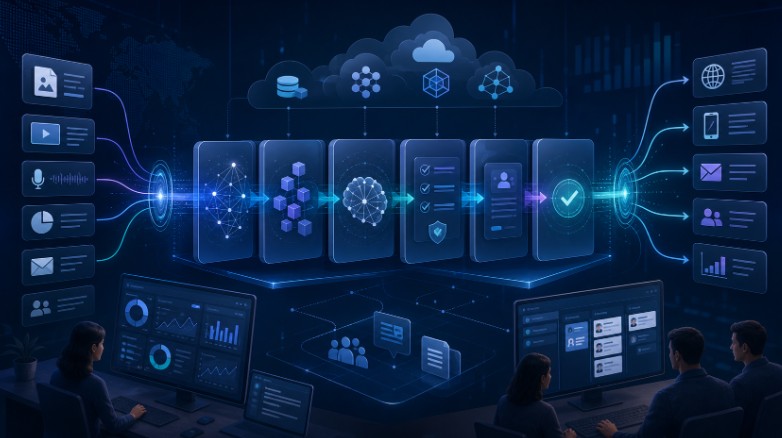
An AI pipeline is a directed graph of processing steps that transforms an input into an output through a series of automated stages. Each stage performs a specific transformation — parsing raw content, applying a machine learning model, running validation checks, routing to human review, publishing to a destination system — and passes its output to the next stage in the chain.
The stages themselves vary by use case, but the architectural pattern is consistent. A trigger initiates the pipeline: a new commit in a repository, a file uploaded to a CMS, a ticket opened in a helpdesk, or a scheduled cron job. The trigger event carries metadata about the source, the content type, and the processing requirements. The pipeline then routes the content through the appropriate stages, applying models where machine intelligence adds value and deterministic checks where reliability matters most.
Modern pipelines also include observability at every stage. Logs, metrics, and traces let operators see exactly which stage each item is in, how long each stage is taking, and where failures cluster. This observability separates production-grade pipelines from prototypes — a pipeline you cannot inspect is a pipeline you cannot trust with real business content.
The most sophisticated implementations add feedback loops: results from downstream stages inform upstream decisions. A translation memory that grows with every translation. A quality classifier that learns from human corrections. A routing engine that reassigns work based on measured performance. These loops turn an AI pipeline from a static automation into an adaptive system.
Why Content Operations Depend on These Systems
Content operations benefit from AI pipeline architecture more than most functions because content is inherently probabilistic and inherently continuous. Every string of text needs judgment: is this the right register, the right tone, the right terminology? Every content update needs propagation: to translations, to documentation, to marketing collateral, to legal review. And every change needs validation: did the placeholder variables survive, did the length constraints hold, did the terminology stay consistent?
Manual processes cannot keep pace with the compounding volume. A mid-sized SaaS company might generate a thousand new user-facing strings per week between product releases, marketing campaigns, and support content. Translating that volume by hand across ten languages is roughly ten thousand items per week. Reviewing that volume adds another ten thousand human touches. The math simply does not work at any headcount that a growth-stage company can afford.
AI pipelines change the economics by handling the routine work automatically and reserving human attention for the segments that require judgment. A translation memory match produces an instant translation. A machine translation engine handles novel content. A quality estimation model flags outputs that need review. A human reviewer touches only the flagged segments, at a rate several times faster than translating from scratch.
A Working Example: Localization Pipelines in Practice
Localization is one of the clearest domains where AI pipelines have moved from theory to production. The workflow typically starts when a developer commits a new user-facing string to the source repository. A webhook notifies the localization platform, which pulls the updated resource files and identifies new or changed segments. The platform then applies translation memory matches for segments similar to past translations, sending the remainder to a machine translation engine chosen based on target language and content type.
The machine output flows through a quality estimation model that scores each translated segment. High-confidence segments proceed to automated placement in the resource files. Lower-confidence segments route to a human reviewer, who works in an in-context editor that shows the string in its actual UI position. When the reviewer approves the translation, it flows back into the pipeline, updates the translation memory for future reuse, and lands in the source repository as a pull request.
This entire cycle can complete in a day or two for most content, and in near-real-time for high-priority segments. What used to be a batch process running once per quarter now runs continuously alongside development, with translation memory and glossary compounding value with every project.
How to Design an AI Pipeline That Works
Building an AI pipeline that actually delivers value requires more than connecting APIs. The design choices at the beginning of a project determine whether the pipeline will scale gracefully or collapse under its own complexity.
Single source of truth for content. Every piece of content that flows through the pipeline should originate from one canonical location — a repository, a CMS, a database — and every version should be traceable back to that source. Pipelines that ingest from multiple uncoordinated sources develop drift problems that compound over time.
Human-in-the-loop by default. AI models make mistakes, sometimes subtle ones that only surface after content has shipped. A well-designed pipeline routes low-confidence outputs to human review as a matter of course, and treats fully automated output as the exception that requires additional validation.
Observability at every stage. Every input, every model call, every human decision, every output must be logged in a way that lets operators diagnose problems after the fact. Pipelines without observability accumulate technical debt that only becomes visible during production incidents.
Versioning for both models and data. AI models change over time as vendors release new versions and as teams retrain custom models on new data. Without versioning, teams lose the ability to reproduce past outputs, which becomes critical during audits, disputes, or quality regressions.
Graceful degradation. Every stage in the pipeline should have a defined failure mode that lets downstream stages continue where possible. A model outage should not stop the entire pipeline; it should route affected items to a fallback engine or a manual queue.
Common Pitfalls in Adoption
Even teams that follow good design principles tend to stumble on a few recurring pitfalls. The first is over-reliance on a single model provider. Pipelines that hard-code a specific vendor become fragile when that vendor changes pricing, deprecates an API, or introduces breaking changes. Modern pipelines abstract model providers behind a common interface, allowing the team to swap engines without redesigning the workflow.
The second is under-investment in the human review layer. Teams that build sophisticated automation often treat human review as an afterthought — a rushed interface, poor tooling, no context. This produces bottlenecks that undo the throughput gains from automation. The human layer deserves the same design attention as the machine components.
The third is ignoring the total cost of ownership. AI pipelines involve model inference costs, human review costs, engineering maintenance costs, and opportunity costs from things the pipeline gets wrong. Teams that budget only for model API charges consistently underestimate the true cost by a factor of two or three.
Frequently Asked Questions
What is an AI pipeline in enterprise contexts?
An AI pipeline is an automated workflow that connects multiple processing steps — including machine learning models, deterministic checks, and human review — into a continuous system that transforms input content or data into a finished output. Enterprise pipelines typically include integrations with content systems, observability at every stage, and feedback loops that improve the pipeline over time.
How is an AI pipeline different from traditional automation?
Traditional automation applies deterministic rules to predictable inputs. AI pipelines add probabilistic model inference, which lets them handle inputs that would require judgment from a human. The trade-off is that AI outputs need validation — either automated confidence scoring or human review — because model errors are less predictable than rule-based failures.
How much does an AI pipeline cost to build and operate?
Costs vary widely by scope. A simple content pipeline connecting a CMS to a translation service might cost a few thousand dollars per month in infrastructure and model inference. Enterprise-scale pipelines with dedicated engineering, custom models, and managed services can reach hundreds of thousands per year. The largest cost variable is typically model inference volume, followed by human review labor.
What roles do people play in an AI pipeline?
People typically appear in three roles: as reviewers who validate AI outputs for high-stakes content, as operators who maintain and monitor the pipeline itself, and as content producers who create the input material. Well-designed pipelines minimize routine human touches while making the remaining decisions high-leverage.
Can small teams build AI pipelines, or is this only for enterprises?
Small teams can absolutely build effective AI pipelines using off-the-shelf platforms. The barrier is not scale but discipline: even a small pipeline needs source-of-truth content, human review policies, observability, and versioning. Many small teams start with a single content type and one target output, then expand as operational maturity grows.
How do AI pipelines evolve as models improve?
Well-designed pipelines are model-agnostic at the interface layer, so upgrading a model does not require rewriting the pipeline. When a new generation arrives, the team swaps the engine, re-runs a validation set, and adjusts confidence thresholds. Pipelines that hard-code a specific model tend to require major rework each generation.
Conclusions
AI pipelines have moved from experimental architecture to operational infrastructure in the span of a few years. Every mature enterprise now runs several of them, often without naming them as such — the content operations that produce localized product releases, the support systems that route tickets across languages, the marketing tools that generate campaign variations, all rely on the same underlying pattern of automated stages connected through orchestration layers.
For teams thinking systematically about how to build these systems, the underlying discipline is closer to traditional data engineering than to standalone machine learning. It combines familiar practices — pipelines, observability, versioning, testing — with the newer challenges of managing probabilistic outputs and human-in-the-loop workflows. Teams that treat AI pipelines as engineering infrastructure rather than experimental prototypes tend to reach production maturity fastest.
For a broader perspective on how these systems are evolving across industries,MIT Technology Review publishes regular deep dives into the state of enterprise AI adoption, including the operational challenges that emerge as organizations scale from pilots to production. Its coverage is one of the more balanced sources of long-form analysis in the space and complements the tool-specific guides that vendors produce with a more independent editorial perspective.