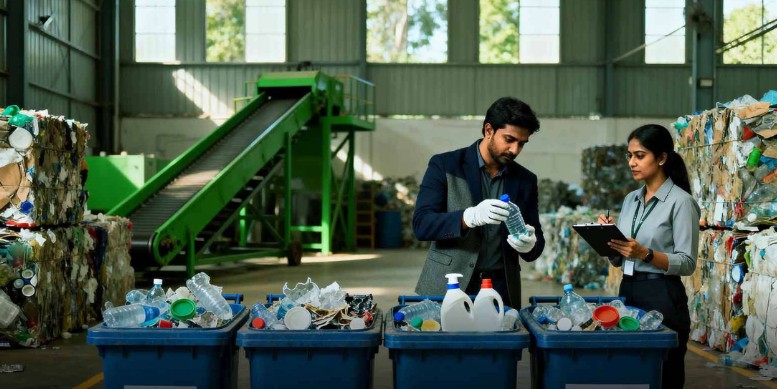
There is an increased emphasis on ethical production practices while the global industry is moving towards a more circular economy. Banyan Nation is bringing this to reality by employing cutting-edge technology to rethink how we can manage waste and produce new raw materials from waste. By combining the informal recycling workers with an efficient data-driven supply chain, we fill a gap between supply and demand for environmental protection and sustainability. Additionally, plastic recycling will provide an essential element for the future of manufacturing, paving the way for brands to achieve lower carbon footprints while maintaining high product quality and performance in an environmentally conscious world.
A History of Responsible Manufacturing
For decades, the manufacturing sector has operated under the traditional “take, make, dispose” model, where raw materials are taken from land, turned into products, and then disposed of, contributing to significant environmental degradation. However, today, the “Future of Manufacturing” has become synonymous with sustainability. Responsible manufacturing is not limited to the factory floor; it has become synonymous with accountability across the product’s entire lifecycle.
The core of the evolution of the concept of sustainability in manufacturing lies in the understanding that the conventional perception of plastic as a pollutant must be replaced by the view that it is a valuable material that can be kept in circulation indefinitely.
The Role of Technology in Plastic Recycling
One of the biggest barriers in the past was the quality of recycled materials. Conventional recycling practices have produced plastics of inferior quality, which are not suitable for primary packaging or industrial applications. However, innovative companies have designed proprietary technology for cleaning and sorting plastics, which is a game-changer.
1. Contaminant Elimination:
With current advancements in technology, you can achieve more than 98% removal of contaminants from surfaces (e.g., ink, tape & adhesive residues).
2. Data Analytics:
Waste material can be tracked with the help of both mobile and cloud technology, which creates a traceable and ethical supply chain.
3. Scientific Cleaning:
Hot washing, when using sophisticated technology, allows for plastic flakes to be brought back to near-original status through basic principles of chemistry.
4. Deodorising:
New and more advanced extruders will effectively remove volatile organic compounds, or VOCs, from the resin that has been recycled, making it safe for food contact applications.
These innovations have transformed plastic recycling from a mundane waste management practice into a sophisticated manufacturing process.
Why Sustainable Plastic Recycling is the Strategic Choice
The choice between recycled plastics and virgin plastics affects the bottom line as much as the planet. More manufacturers are realising that sustainable plastic recycling is the strategic choice for many reasons:
1. Supply Chain Resilience:
By using local waste, we can reduce our reliance on foreign fossil fuels and stabilise our raw-material costs by removing the effect of oil price fluctuations.
2. Regulatory Compliance:
The implementation of Extended Producer Responsibility (EPR) regulations requires manufacturers to ensure that a minimum percentage of recycled material is used in their final products, or they face severe financial consequences.
3. Efficient use of energy:
Energy-efficient production of resins through plastic recycling uses much less energy and is up to 80% efficient for certain types of plastics compared to producing virgin plastic through similar methods.
4. Company commitment:
The buying habits of today’s consumers show they want to support brands that are working to sustain the environment; therefore, recycled products being marketed as environmentally friendly are an excellent way to build brand loyalty with modern consumers.
Closing the Loop: The “Design for Recycling” Philosophy
The future of manufacturing begins on the drawing board. To make plastic recycling truly successful, we must design our products with recycling in mind. This philosophy, termed “Design for Recycling”, promotes manufacturers making packaging simpler.
1. Mono-Materiality:
The use of a single type of plastic, such as 100% HDPE, in a package facilitates easier processing during plastic recycling.
2. Washable Adhesives:
The ability to easily peel labels in the hot wash phase prevents contaminants from entering the final resin product.
3. Optimisation of Colour:
Excluding colours like carbon black from products will allow automated sorting devices to optimise their collections, resulting in greater volumes being recycled.
4. Compatible Materials:
Using compatible materials to develop the caps and seals of the products will streamline the plastics recycling process.
Economic and Social Impact
- The plastic recycling process has an important economic and social impact. Many businesses are able to provide a formal job, afford their employees a sense of dignity and provide them with a consistent income, unlike the thousands of individuals that work within the informal economy.
- Additionally, the industry is on track to contribute billions to the world’s GDP. As more and more brands are making a commitment to using post-consumer recycled content, the demand for quality plastic recycling infrastructure will continue to rise, helping to drive further innovation and the creation of “green collar” jobs worldwide.
Overcoming the “Virgin Quality” Myth
One of the biggest myths in the plastic recycling industry has been that recycled plastics cannot compete with “virgin” materials in terms of thermal or mechanical performance. However, through rigorous testing and precision engineering, today’s “Better Plastic” has proven itself on par with its “virgin” competitors in every aspect, from auto bumpers to shampoo bottles, in successful applications of “high-grade” resins made from plastic recycling.
The Road Ahead: A Circular Future
As the world moves towards 2030 and beyond, the manufacturing sector will be determined by the efficiency of the circular economy in “closing the loop”. Every organisation aiming to be socially responsible strives to evolve from being a ‘consumer of resources’ to being a ‘manager of resources’.
1. Scalability:
Providing recycling facilities that can assist in managing millions of tonnes (50 kg each) of waste produced annually.
2. Collaboration:
Recyclers, brand owners, and governments are banding together to develop a universal waste collection and reporting framework.
3. Education:
Supporting the creation of educational programmes to promote the importance of separating waste at the source to assist in the ease of plastic recycling.
The industry makes certain that plastic recycling continues to be an important aspect of the manufacturing ecosystem by investing in these areas, therefore making it economically feasible (cost-effective) for manufacturers.
Final Thought
A sustainable planet involves more than aspiration—it also needs large, industrial-scale, ethical and efficient solutions. Industrial partnerships such as those with Banyan Nation can allow recycling of high-quality plastics and help manufacturers to move toward a circular economy, in which each component of a product after its life has measurable value. Embracing high-quality plastics recycling allows a brand to honour its environmental pledge while establishing that brand’s long-term viability within the global industrial ecosystem. Sustainable manufacturing changes the entire paradigm of how we will compete in the global economy moving forward, and it is essential to our responsibility to the next generation and to achieving economic growth without compromising the health of our planet.